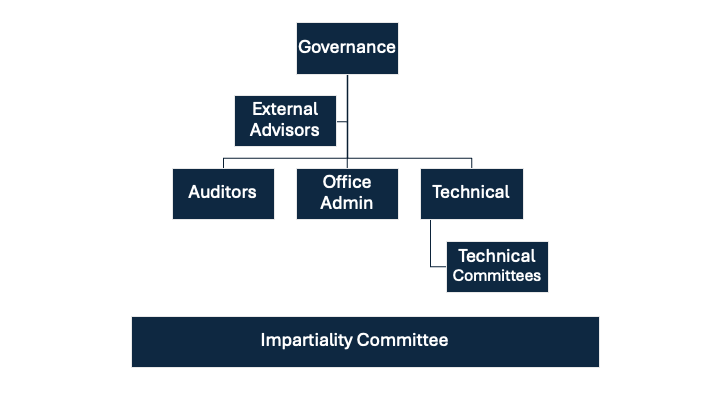
Roles, Responsibilities & Authorites
Role Descriptions
Governance Board
The Governance Board provides strategic oversight and ensures that the organisation operates ethically, impartially, and in line with accreditation requirements. They are responsible for approving policies, supervising finances, and ensuring adequate resources for certification activities.
They also oversee delegation of authority, review high‑level risks, and provide accountability for the organisation’s performance. Their role ensures long‑term stability, integrity, and governance across all certification functions.
Lead Auditors
Lead Auditors are responsible for planning, coordinating, and delivering management system audits in accordance with ISO 17021-1, ISO 17065 and specific scheme requirements (e.g., ISO 27001). They lead the audit team, ensure that audit objectives are met, apply risk‑based thinking during audit execution, and maintain impartiality throughout the process. As team leads, they manage communication with the client, verify evidence, and complete audit reporting to a high standard.
Lead Auditors also support auditors‑in‑training by mentoring, supervising, and validating their audit work. Lead Auditors play a key role in audit programme management, audit time determination, and multi‑site sampling verification. Although they do not make certification decisions, they provide critical inputs through thorough and impartial audit findings.
Auditors (A2)
Auditors support audit activities under the direction of the Lead Auditor. They are responsible for conducting interviews, reviewing evidence, assessing conformity, and documenting findings in line with audit requirements. They must maintain accurate notes, uphold confidentiality, and ensure that judgement is based solely on evidence.
They contribute to audit planning, remote auditing, and site activities, while ensuring effective communication with clients and team members. Auditors are also required to maintain competence through CPD, witness audits, and training, supporting the broader certification process by providing clear and reliable audit results.
Technical Experts
Technical Experts provide specialist knowledge relevant to a client’s industry, processes, or technology. They supplement the audit team where deeper technical insight is required, ensuring that audit judgements are informed by competent sector‑specific understanding. They contribute to planning, evidence review, sampling, and technical clarification.
Within the RACI framework, Technical Experts are consulted or responsible for tasks where technical depth is necessary—such as determining audit time using technical criteria or evaluating client product/process controls. They do not lead audits or make certification decisions, but they strengthen audit validity and enhance the credibility of audit conclusions.
Office Admin Staff (A4)
Office Administration Staff support the certification workflow by coordinating logistics, managing documentation, and ensuring that communication between clients and auditors is efficient. They arrange audit scheduling, assist with application reviews, handle contractual documentation, and maintain certification records.
They are responsible for ensuring administrative tasks comply with certification body policies and processes. While not involved in audit decision‑making, they play a vital supporting role in enabling audits to run smoothly and ensuring the accuracy, completeness, and security of certification documentation.
Technical Manager & Certification Committee (A3)
The Technical Manager and Certification Committee oversee the technical integrity and impartiality of the certification process. They evaluate audit reports, provide technical oversight, and are accountable for final certification decisions. Their role ensures compliance with ISO 17021‑1, ISO17065, scheme‑specific requirements, and internal policies.
They supervise implementation of processes, validate audit planning (including multi‑site sampling), assess risks to impartiality, and ensure adequate auditor competence. They are ultimately responsible for upholding the credibility, consistency, and fairness of all certification outcomes.
Quality Manager
The Quality Manager ensures that the certification body’s management system is implemented, maintained, and continually improved. They oversee internal audits, corrective actions, document control, and performance monitoring of certification activities.
They are accountable for the quality of processes that underpin impartial certification delivery, including complaint handling, risk review, and ensuring processes meet accreditation requirements. They work closely with governance structures to maintain integrity, assurance, and continual improvement.
Competence Evaluator
Competence Evaluators assess the qualifications, experience, and demonstrated competence of auditors and technical experts. They review evidence, audit logs, training records, and witness assessments to ensure personnel meet ISO 17021‑1, ISO 17065 and scheme‑specific competence criteria.
They are accountable for determining competence sign‑off, approving scopes, and ensuring ongoing competence through annual reviews and witnessed audits. Their work ensures the certification body employs competent and capable personnel.
Technical Committees
Technical Committees provide expert consultation on technical areas, certification schemes, sector‑specific issues, and scheme changes. They support development of new certification schemes, evaluate technical content, and ensure that requirements remain current and relevant.
They are consulted on key decisions that require specialist insight, such as risk register reviews, scheme modifications, or technical interpretations. Their role strengthens the credibility and technical robustness of certification activities.
Impartiality Committee
The Impartiality Committee safeguards the Assurco’s independence and neutrality. It monitors threats to impartiality, reviews risks, and ensures that commercial, personal, or organisational pressures do not influence certification outcomes. Ensures compliance with our Impartiality Policy.
They are responsible for investigating impartiality concerns and challenging organisational decisions where necessary. Their oversight ensures that certification processes remain free from conflict of interest, maintaining trust with clients and accreditation bodies.
Guides
Guides support audit teams during onsite activities by arranging access, coordinating interviews, explaining site rules, and facilitating navigation through the client organisation. They ensure that the audit proceeds efficiently and safely.
They do not influence audit results but play a crucial operational role by providing clarifications and logistical support as requested by auditors. Their presence helps ensure audits run smoothly and disruptions are minimised.
Responsibilities
Assurco operates clear separation of responsibilities with with client as follows:
Client Responsibility
It is the client’s responsibility to consistently achieve the intended results of implementation of the management system standard and conformity with the
requirements for certification. The client will also update Assurco about any significant changes to their organisation and management system, read more.
Assurco Responsibility
It is Assurco’s responsibility to assess sufficient objective evidence upon which to base a certification decision.
Based on audit conclusions, we will make a decision to grant certification if there is sufficient evidence of conformity, or not to grant certification if there is not sufficient evidence of conformity.
However it should be noted that auditing is a sampling exercise and does not guarantee conformity.
Here are two‑paragraph role and responsibility descriptions for each role listed on Row 3 of the RACI matrix (Sheet 1 of your file).
I’ve written them to be clear, concise, and aligned directly with the duties implied by the matrix.
Authorities
6.1.1 The Assurco Organisation Chart clearly identifies the duties, responsibilities and management authorities.
6.1.2 Our structured and managed approach to certification activities safeguards impartiality.